Exhibition “Primaarid” and panel discussion
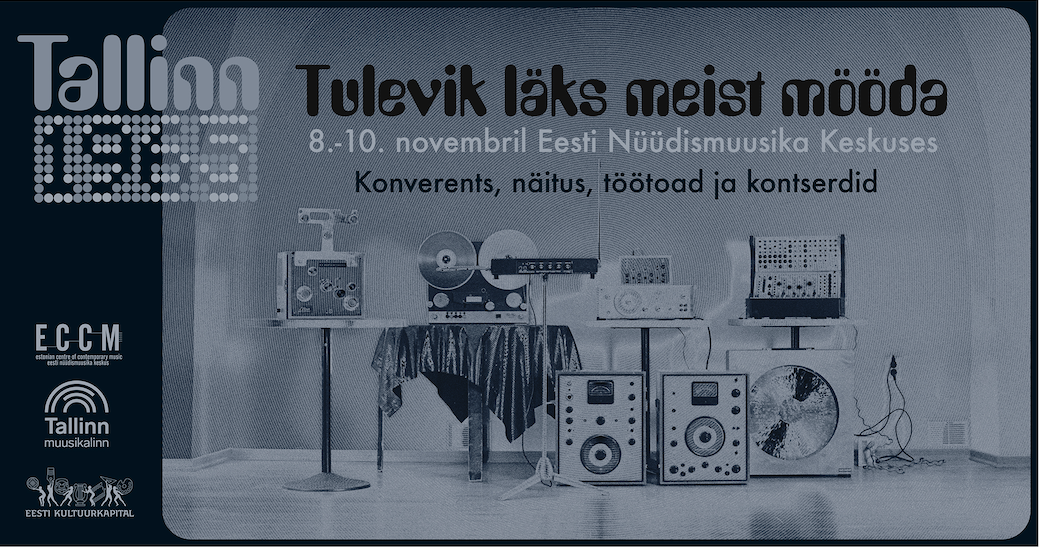
Primaarid is an exhibition of firsts. On show are machines and instruments that have been pioneers: they helped create unprecedented sound fields, entirely new musical styles and new ways of thinking about sound. They carry elegant instrument design, but more importantly an undetermined potential, because their agency is open in form. At the opening of the exhibition Kaarel Kurismaa and Kiwa will play, and Margo Kõlar, Taavi Kerikmäe and Mikko Ojanen will talk about the instruments.
The exhibition shows almost 15 instruments, most of which you have previously seen only in photographs or from very far away.
- Buchla 100 is a synthesiser created by Don Buchla in the 1960s, commissioned by the California Tape Music Center. Morton Subotnick's album “Silver Apples of the Moon” (1967), for example, was made on such a Buchla system.
Igor Zubkov's String Exiter is an experimental electromagnet built in Tallinn, commissioned by Taavi Kerikmäe, used to play the metal strings of musical instruments.
- Springer Tempophon is a device made in the 1950s that makes it possible to change the speed of a recording without affecting its pitch, and also to change the pitch while keeping the speed the same. The Springer Tempophon was used in Stanley Kubrick's 1968 film “2001: A Space Odyssey” to modify the voice of the AI system HAL 900. The Tempophon on show comes from a studio of Bucharest radio.
- The Serge modular synthesizer is a synthesiser designed by Serge Tcherepnin in the early 1970s. The synthesiser on show is an early generation, so-called Paperface version, dating from the mid-1970s. The synthesiser originally belonged to the American composer Michael Manion, who also worked as an assistant to Karlheinz Stockhausen.
- The Hohner electronium is a valve synthesiser with its accompanying amplifier, created by the instrument designer René Seybold and produced by Hohner from 1950. Stockhausen's group used such an instrument in performances of works such as Pole and Kurzwellen in the 1960s.
- The BEAG AKX-200 tape delay is a device produced in Hungary in the 1970s. The echo machine on show was used by Sven Grünberg in his electronic work of the 1970s and 1980s, including the music for the film “Hukkunud alpinisti hotell”.
- The Clavioline is a valve synthesiser from the 1950s, made in numerous versions. Sven Grünberg used such an instrument on his legendary albums “Hingus” and “OM”.
- The Retakord is an electric organ with an amplifier and loudspeaker, produced at the Punane RET radio factory from 1965 to 1975. It was the first industrially produced polyphonic electric organ in the Soviet Union. The organ's design and technical solution were based on the work of Heino Kalmo.
- The theremin (Teremin) is one of the earliest electronic music instruments. It was created in the 1920s by Leon Theremin. The instrument on show is the Etherwave model created by Bob Moog in 1996.
- The Alesis HR 16 drum machine is a device from the 1980s on which Sven Grünberg made the rhythm tracks for the animated film “Naksitrallid” (1984).
- The wax cylinder recorder and player is one of the earliest sound recording devices, developed at the end of the 19th century. The device on show dates from the early 20th century, probably from a post office.
- The Brüel & Kjaer 1022 is a laboratory valve oscillator from the 1960s, used in their early electronic work by the important electronic music studios in Milan and Cologne, and also at the BBC.
- The modular synthesiser made by Härmo Härm dates from the late 1970s. Härm built it for Kaarel Kurismaa.
Erkki Kurenniemi's electronic musical instruments
The Finnish electronic music pioneer Erkki Kurenniemi (1941 to 2017) designed and built ten unique electronic musical instruments from 1964 to 1975. With his instruments Kurenniemi sought to solve a central problem of the time: studio work based on time-consuming tape manipulation was cumbersome. Kurenniemi's idea was to replace it with automated and algorithmic processes of composition and music making. His computer-based approach to making new music was inspired by the Columbia-Princeton Electronic Music Center and by the early design ideas of the Elektronmusikstudion in Stockholm, Sweden. Kurenniemi built his early “digital” synthesisers using microchips and developed memory modules for his instruments. These were quite unexpected technical solutions for an electronic musical instrument of the 1960s.
The exhibition includes two of Kurenniemi's instruments, which can be heard at the Saturday evening concert. DICO (a copy of the main interface of the original 1969 instrument) is a 12-step sequencer-synthesiser that Kurenniemi built for the Finnish composer Osmo Lindeman. The instrument is programmed by touching grounded metal pins, switching the corresponding ten bits of binary code on or off.
DIMI-A (1970) is a 256-step sequencer-synthesiser with two sound generators. The instrument is programmed by touching metal plates with two styluses.
vimeo.com/80931815
Tickets: the event is free. On 9 and 10 November the exhibition is open to conference guests: fienta.com/et/tallinn-1965-tulevik-laks-meist-mooda